Few figures loom as large in Scottish history as William Wallace. This William Wallace history explores the life of a man shaped as much by legend as by fact. Emerging during one of Scotland’s darkest periods, Wallace rose at a time when the nation’s independence hung by a thread and resistance carried a terrible personal cost.
This is the story of the man behind the myth.
Scotland Under English Rule
By the late 13th century, Scotland was in political chaos. Following the death of King Alexander III and the collapse of the royal line, Edward I of England—later known as “Longshanks”—moved swiftly to assert control.
English garrisons occupied key castles, Scottish nobles were forced to swear loyalty, and resentment simmered across towns, villages, and rural communities. Many accepted English rule as unavoidable. William Wallace did not.
William Wallace and the Making of a Rebel
Little is known for certain about Wallace’s early life. He was likely born in the 1270s, possibly in Renfrewshire, and belonged to the lesser gentry rather than the aristocracy. Unlike many leaders of the time, Wallace did not inherit land, titles, or political power.
What he did possess was determination.
By 1297, Wallace had begun leading violent resistance against English officials and collaborators. His attacks were fast, local, and disruptive—striking at symbols of authority before vanishing back into the countryside. These early actions marked the beginning of a wider uprising.
Victory at Stirling Bridge
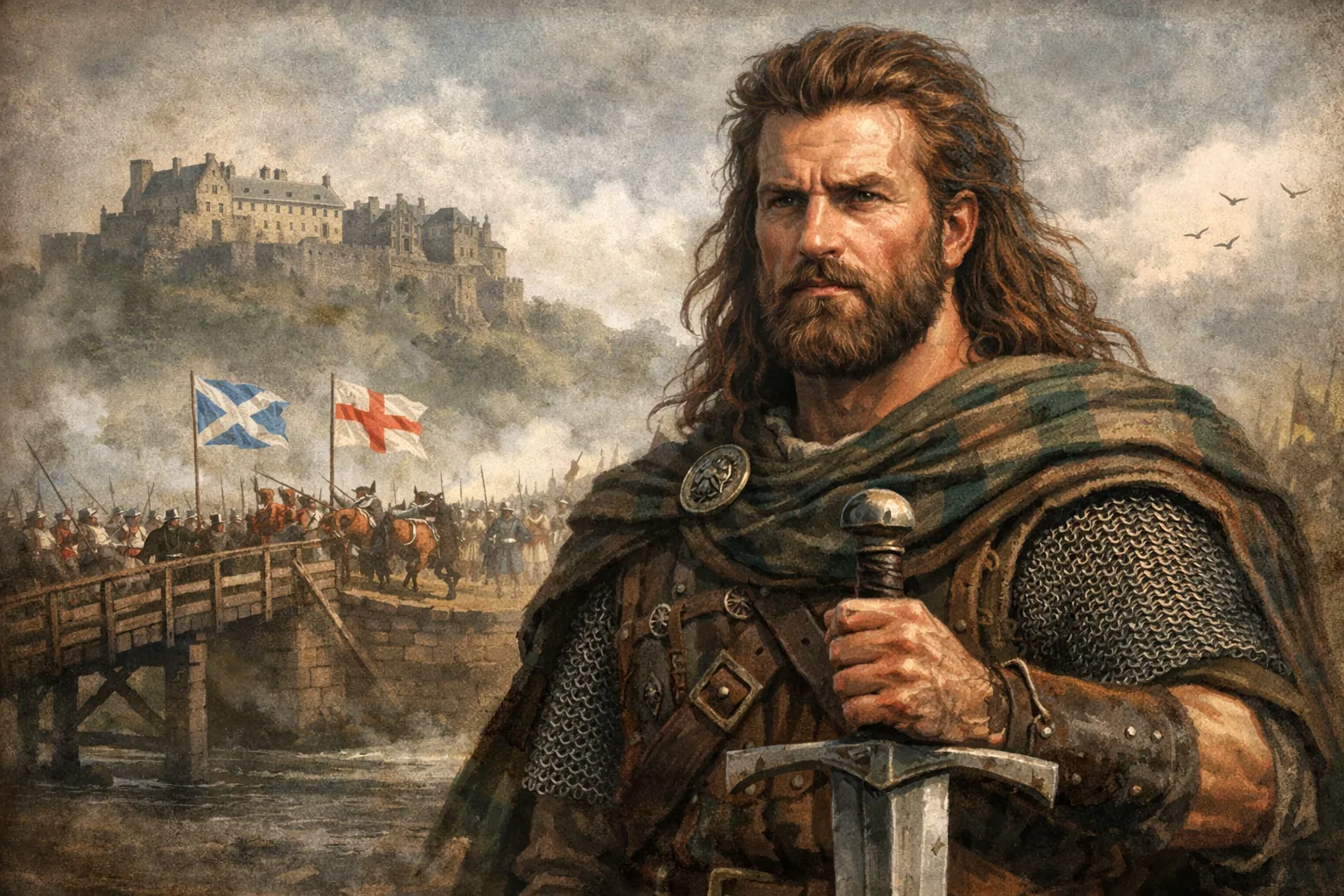
Wallace’s defining moment came at the Battle of Stirling Bridge.
Facing a larger and better-equipped English army, Wallace and his ally Andrew Moray used the landscape to their advantage. The narrow wooden bridge crossing the River Forth forced English troops to advance in stages. When enough soldiers had crossed, the Scots attacked, cutting them off from reinforcements.
The result was a crushing English defeat and one of the most significant Scottish victories of the medieval period. It proved that English forces could be beaten and transformed Wallace from rebel leader into national figure.
In the aftermath, Wallace was appointed Guardian of Scotland.
Defeat at Falkirk
Success brought consequences.
In 1298, Edward I personally led a massive army north to confront the Scottish resistance. At the Battle of Falkirk, Wallace relied on tightly packed infantry formations known as schiltrons. While effective defensively, they proved vulnerable to English longbowmen and cavalry.
The Scottish army was decisively defeated. Wallace resigned as Guardian soon after, and leadership passed to others, including Robert the Bruce. Wallace himself faded from public view but did not abandon the cause.
Capture and Execution
For several years, Wallace remained a fugitive, continuing resistance efforts where possible. In 1305, he was betrayed and captured near Glasgow. He was taken to London and charged with treason.
Wallace rejected the charge, stating that he could not betray a king he had never sworn allegiance to.
His execution was deliberately brutal: hanged, drawn, and quartered. His head was displayed on London Bridge as a warning to others who might resist English rule.
Instead, it ensured his immortality.
Legend vs History
Wallace’s reputation grew rapidly after his death. Poems, chronicles, and later national storytelling elevated him into a heroic symbol of freedom. Much of what is popularly believed comes from later sources rather than contemporary records.
The 1995 film Braveheart introduced Wallace to a global audience but also reinforced many historical inaccuracies. Kilts, face paint, and dramatic speeches reflect legend rather than medieval reality.
Yet the core truth remains: Wallace chose resistance when submission was safer.
Why William Wallace Still Matters
William Wallace did not live to see Scotland regain independence, but his actions helped ignite a movement that continued long after his death. He demonstrated that opposition was possible and inspired others to continue the struggle.
This enduring influence is why William Wallace history continues to shape Scotland’s national identity today. William Wallace monument
Call to Action
If you enjoyed this exploration of Scotland’s past, share this post and continue the journey at brianwelsh500.com, where castles, history, and legend come together—one story at a time.