Setting the Scene: Goodrich Castle and the River Wye
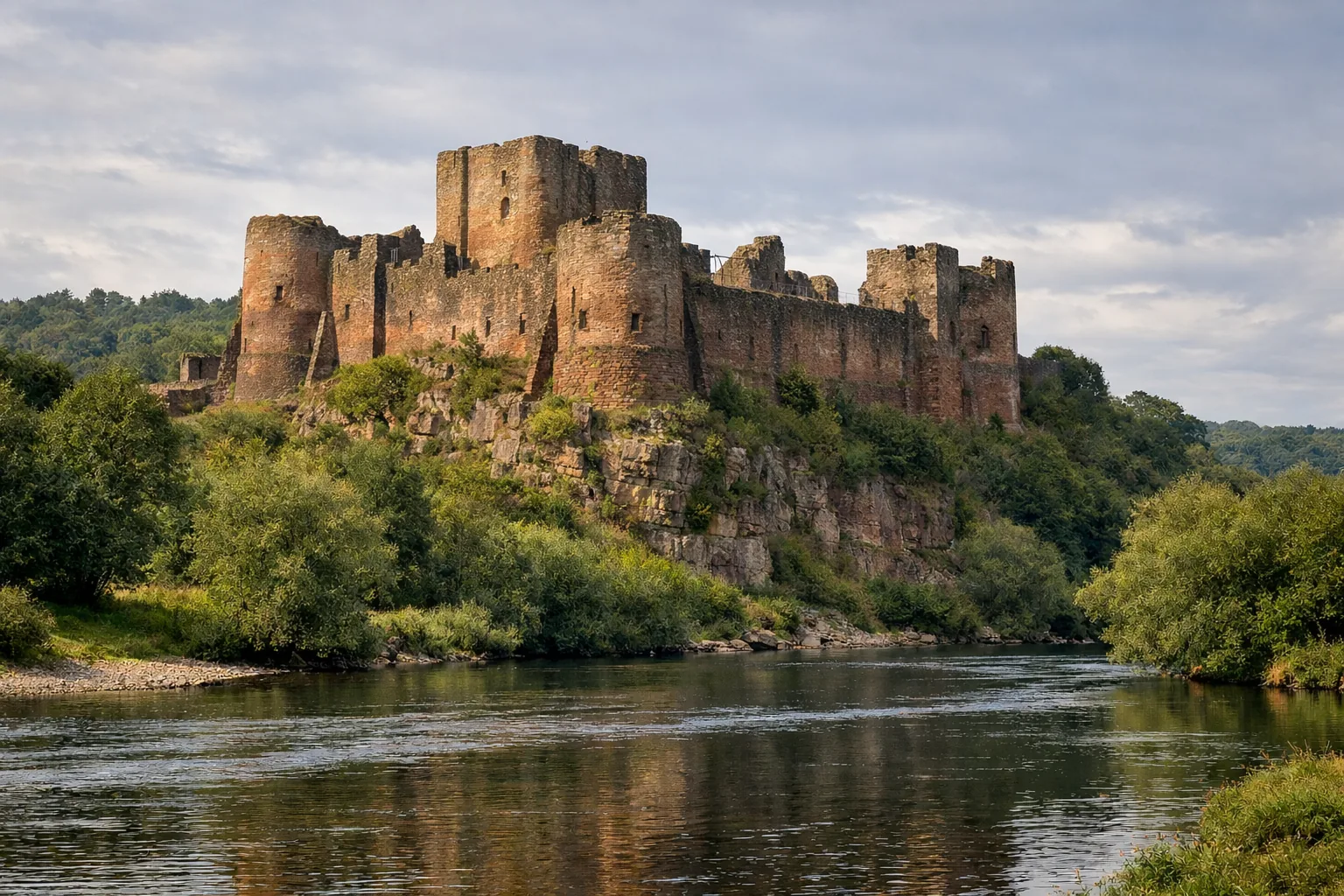
Perched high above the River Wye, Goodrich Castle is one of the most complete and imposing medieval fortresses in the Welsh Marches. Approaching the site today, the landscape does much of the storytelling for you. The river curves below, the wooded hills close in, and the castle rises with a confidence that makes it clear this was never meant to be a quiet country stronghold. Goodrich was built to dominate—both the land and the routes moving through it.
This is a castle designed for control, not comfort.
Like Ludlow Castle, Goodrich Castle was shaped by its position on the Welsh border, where military strength mattered more than comfort or display.
First Impressions: Arrival at Goodrich Castle
Walking up toward the gatehouse, Goodrich immediately feels different from many ruined castles. The walls still stand high and purposeful, enclosing a compact but formidable inner world. There’s a sense of order here—straight lines, thick stonework, and a layout that clearly reflects centuries of military thinking rather than decorative ambition.
Unlike castles built to impress royal visitors, Goodrich feels practical. Every angle serves a purpose. Every wall seems to ask the same question: how do we keep enemies out?
A Castle Shaped by Conflict
Goodrich Castle’s story is inseparable from the violent politics of the Welsh Marches. Originally founded in the late 11th century, the site was expanded and reinforced as border tensions hardened. Over time, it evolved into a near-perfect example of a concentric Norman fortress, with powerful curtain walls, corner towers, and a commanding keep.
The castle passed through the hands of influential Marcher lords, men who ruled these borderlands with near-royal authority. Their power was measured not in ceremony, but in stone, soldiers, and siege readiness.
Goodrich wasn’t just a home—it was a warning.
William de Valence and the Power of the Marches
One of the most influential figures in Goodrich Castle’s story is William de Valence, a powerful Marcher lord and half-brother to King Henry III. Through marriage and royal favour, de Valence gained control of vast estates along the Welsh border, including Goodrich Castle, which he transformed into a serious military stronghold.
Under William de Valence, Goodrich evolved from a defensive residence into a fortress designed for prolonged conflict. The strong curtain walls, corner towers, and reinforced keep reflect the realities of Marcher rule—where rebellion, border skirmishes, and political instability were constant threats.
De Valence’s authority in the region was not always welcomed. His power and foreign influence made him a controversial figure among English barons, yet his legacy at Goodrich is unmistakable. The castle’s stone defences speak directly to his need to rule through strength rather than diplomacy.
Goodrich Castle, as it stands today, owes much of its formidable character to William de Valence’s vision of control, permanence, and readiness for war.
The Keep and Inner Ward
Stepping into the inner ward, the scale becomes clearer. The keep rises at the centre, solid and uncompromising, surrounded by towers that once bristled with defenders. From here, views stretch across the Wye Valley, reinforcing why this location mattered so much.
This wasn’t just about defence. From this height, messages could be sent, movement observed, and control asserted over anyone passing through the valley below. In the medieval world, visibility meant authority.
Siege Warfare and the English Civil War
Goodrich Castle saw its most dramatic action centuries after its medieval peak, during the English Civil War. In 1646, Royalist forces held the castle against Parliamentarian troops, leading to a brutal siege that introduced one of Britain’s earliest recorded uses of a mortar—nicknamed “Roaring Meg.”
The damage inflicted during this siege effectively ended Goodrich’s military role. What stands today is a castle frozen at the moment when warfare outpaced medieval stone defences.
The siege of Goodrich echoes the fate of other strongholds across Britain, including Warwick Castle, where changing warfare rendered medieval walls increasingly vulnerable.
Living at Goodrich: More Fortress Than Home
Unlike palatial castles such as Warwick or later royal residences, life at Goodrich would have been stark. The architecture prioritises survival over luxury. Living quarters were functional, storage areas extensive, and movement within the castle tightly controlled.
This was a place for soldiers, administrators, and families who understood that danger was never far away. Comfort was secondary. Readiness was everything.
Exploring the Grounds Today
Today, Goodrich Castle is a rewarding site to explore at a relaxed pace. The layout remains easy to follow, signage is clear, and the surrounding landscape enhances every viewpoint. From the walls, the Wye Valley unfolds quietly, a sharp contrast to the violence that once defined the site.
Why Goodrich Castle Still Matters
Goodrich Castle stands as one of the finest surviving examples of a true Marcher fortress. It tells a story of borders, authority, and conflict without relying on legend or romance. Its strength lies in authenticity.
For anyone tracing the history of the Welsh Marches—from Ludlow to the castles that guarded the frontier—Goodrich is an essential stop. It doesn’t shout for attention. It simply endures.
From Goodrich, the story of the Marches continues south along the River Wye to Chepstow Castle ghost stories and hauntings, where military power, royal ambition, and centuries of reported hauntings add a darker layer to life on the border.