
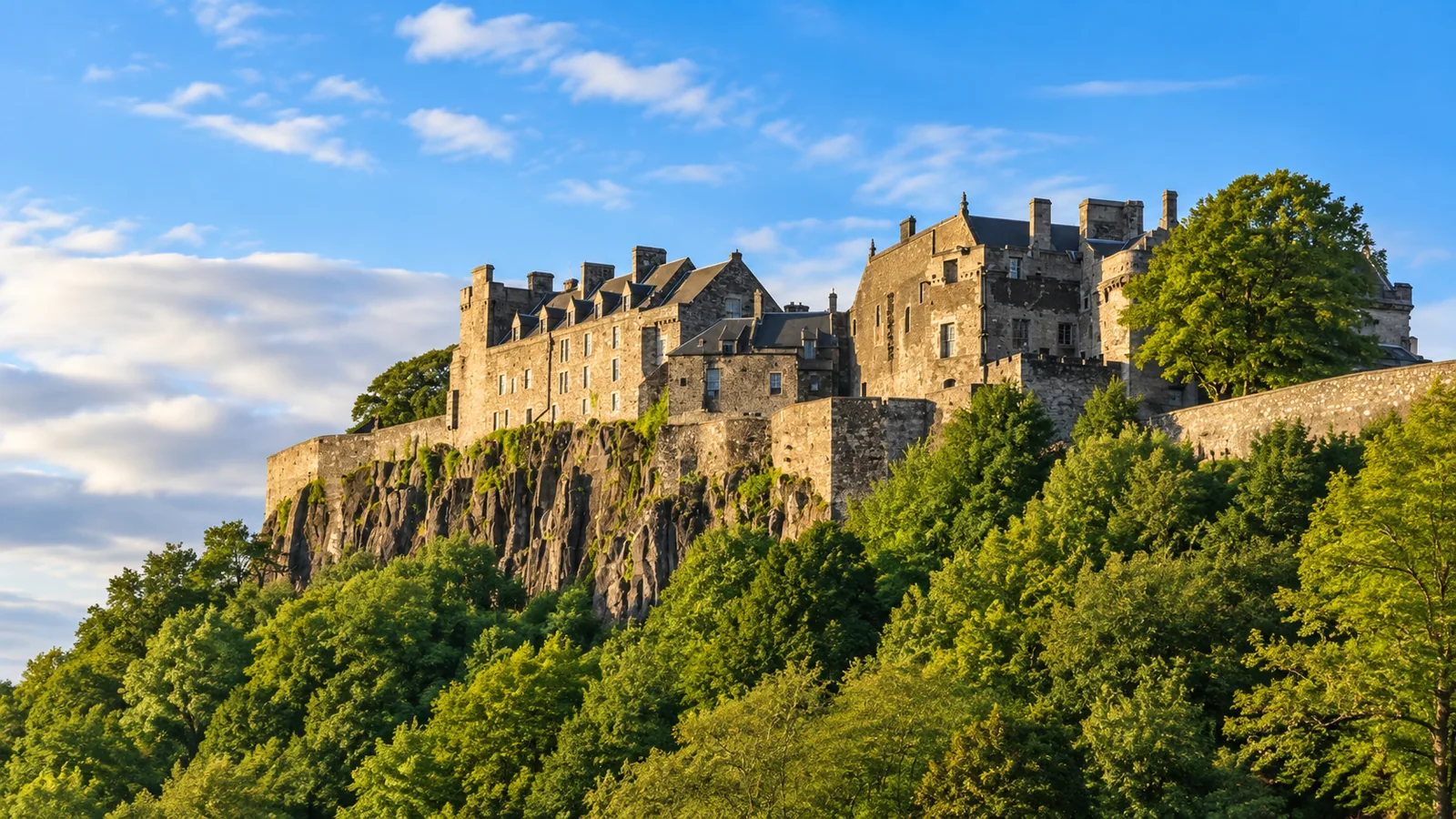
As we climb towards Stirling Castle, the volcanic rock rises above the surrounding countryside and the view opens across the upper Forth valley. This is a place where the landscape tells part of the story: from the walls, we can see why rulers and armies wanted control of the crossing routes through central Scotland.
This Stirling Castle travel guide follows the visitor’s route through its gates, into the royal palace and Great Hall, and back out to the broad views. Along the way, we meet the monarchs who shaped the castle and imagine the busy household that once filled it.
Starting the Walk Around Stirling Castle
As we approach the entrance, Stirling feels different from many of the castles we have visited. It was a fortress, but defence tells only part of its story. Beyond the walls, generations of Stewart monarchs created a royal residence with great halls, palace rooms and courtyards for the court.
The castle’s position also places us close to some of Scotland’s best-known historic sites. In 1297, William Wallace and Andrew Moray helped lead the Scottish victory at the Battle of Stirling Bridge. You can read more about Wallace’s life and his role in the Wars of Independence in our William Wallace article.
Then, in 1314, Robert the Bruce’s forces besieged Stirling Castle. An English army marched north to relieve the garrison, and the two sides met at Bannockburn, just south of the town. These battles happened nearby; the buildings we are about to explore mainly reflect the later royal court.
Through the Forework and into the Great Hall
We pass through the outer defences and reach the Forework, the imposing entrance built for James IV around the turn of the 16th century. Later changes altered its appearance, but it still gives us a sense of how the approach announced royal authority.
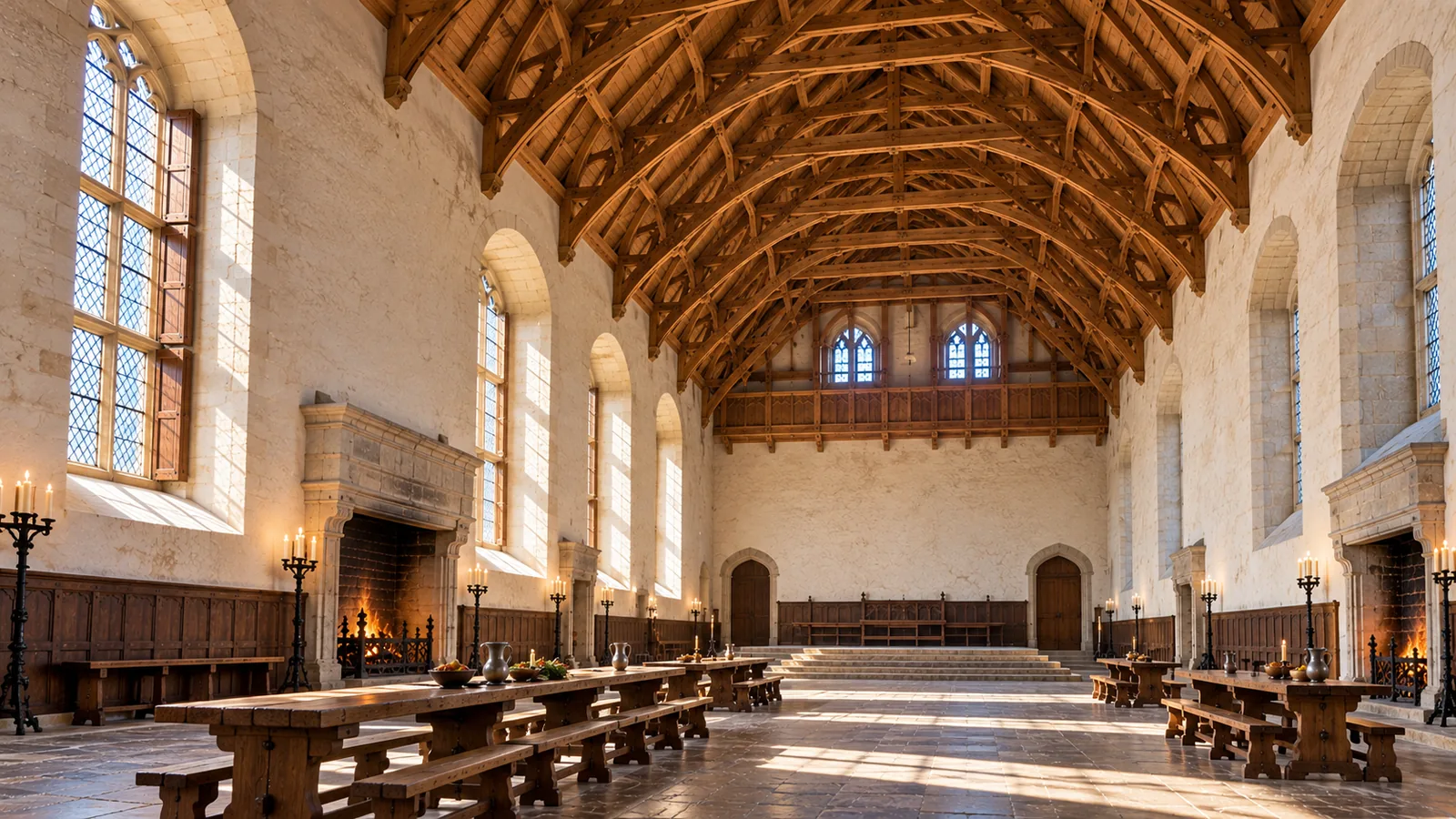
Beyond the gate, the castle begins to feel less like a military stronghold and more like a royal residence. The Great Hall, built for James IV and under construction by 1503, was designed for ceremony, feasting and display. Its scale makes the ambition of the Stewart court easy to picture.
Imagine long tables filling the hall. Servants carry food from the kitchens, musicians entertain the guests, and the royal household gathers beneath the timber roof. Today the room is calmer, but it still gives us a sense of the occasions it was built to host.
Inside the Royal Palace at Stirling Castle
From the Great Hall, we turn towards the Royal Palace. James V developed this Renaissance building in the 1530s and 1540s, drawing on ideas from continental Europe. Its carved stonework and decorated rooms show that appearance mattered as much as strength.
The rooms also reveal how the royal household worked. The closer a visitor came to the king and queen, the more restricted access became. Where someone could go helped mark their place at court, so the palace shaped both daily routines and royal ceremony.
Look Up at the Stirling Heads
In the palace, look up for the carved oak roundels known as the Stirling Heads. Made for James V’s palace in the 16th century, they show kings, queens, courtiers and figures drawn from biblical and classical traditions.
The original carvings once decorated the ceiling of the King’s Presence Chamber. Some originals survive, and visitors can see them displayed in the palace alongside reconstructions that help us imagine how the room may have looked when the ceiling was complete.
Mary, Queen of Scots at Stirling Castle
The palace is also closely connected with Mary, Queen of Scots, who lived here as a child. Born at Linlithgow Palace in December 1542, she became queen after her father, James V, died later that month.
On 9 September 1543, when she was nine months old, Mary was crowned at Stirling Castle. The coronation took place in the Chapel Royal then standing here. The Chapel Royal visitors see today was built for James VI in 1594, ahead of the baptism of his son Prince Henry.
Standing in the castle now, it is hard to picture an infant at the centre of Scotland’s monarchy. Around the young queen, nobles competed for influence while the country faced pressure from England and uncertainty over its future. Mary left Scotland for France in 1548; her story later took her back to Scotland as an adult queen.
Her life reaches far beyond these walls. You can follow the wider story in our Mary, Queen of Scots article.
What Life Inside Stirling Castle Might Have Felt Like
Kings and queens dominate the story, but they were only part of the community behind the walls. If we step into the castle during the 1500s, we can picture kitchens preparing meals, servants carrying water and tending fires, and craftsmen keeping the buildings in repair.
Guards watched the entrances while soldiers protected the fortress. Officials handled royal business, and nobles, musicians and visiting ambassadors crossed the courtyards. On a feast day, the Great Hall would have sounded very different from the quiet room we walk through today: conversation, music and the movement of people filled the space.
It is an impression rather than a minute-by-minute record, but the surviving buildings help us understand the mix of work and ceremony. Stirling Castle was at once a home, a workplace, a palace, a fortress and a centre of royal government.
Robert the Bruce, Stirling Castle and Bannockburn
As we look back across the landscape, it is easy to connect Stirling with Robert the Bruce and the Wars of Scottish Independence. In 1314, Bruce’s forces besieged the castle, which an English garrison held. An agreement meant the garrison would surrender if it did not receive relief by midsummer.
Edward II’s army came north, and the confrontation led to the Battle of Bannockburn on 23 and 24 June. Bruce’s victory became a turning point in the war. The 1314 siege and battle form an important chapter in the castle’s story, though the Renaissance palace we see today belongs to a much later period.
The View from Stirling Castle
Before we leave, let’s pause by the walls and look out again. Somewhere across this landscape lies the ground associated with Stirling Bridge; Bannockburn sits in another direction. The names we know from history now belong to a real place, and the castle’s position makes its importance easier to understand.
For the castle’s history, current opening details and visitor information, see the official Historic Environment Scotland page for Stirling Castle.
Where to Next?
Our walk through Stirling Castle ends with a view across the ground that shaped its history. Next, we’ll follow that landscape to the Battle of Stirling Bridge and the story of William Wallace and Andrew Moray. After that, we’ll continue to Bannockburn and Robert the Bruce.
If you enjoyed walking through Stirling Castle with me, please share this article and keep exploring the castles, battlefields and historical figures on brianwelsh500.com.


