
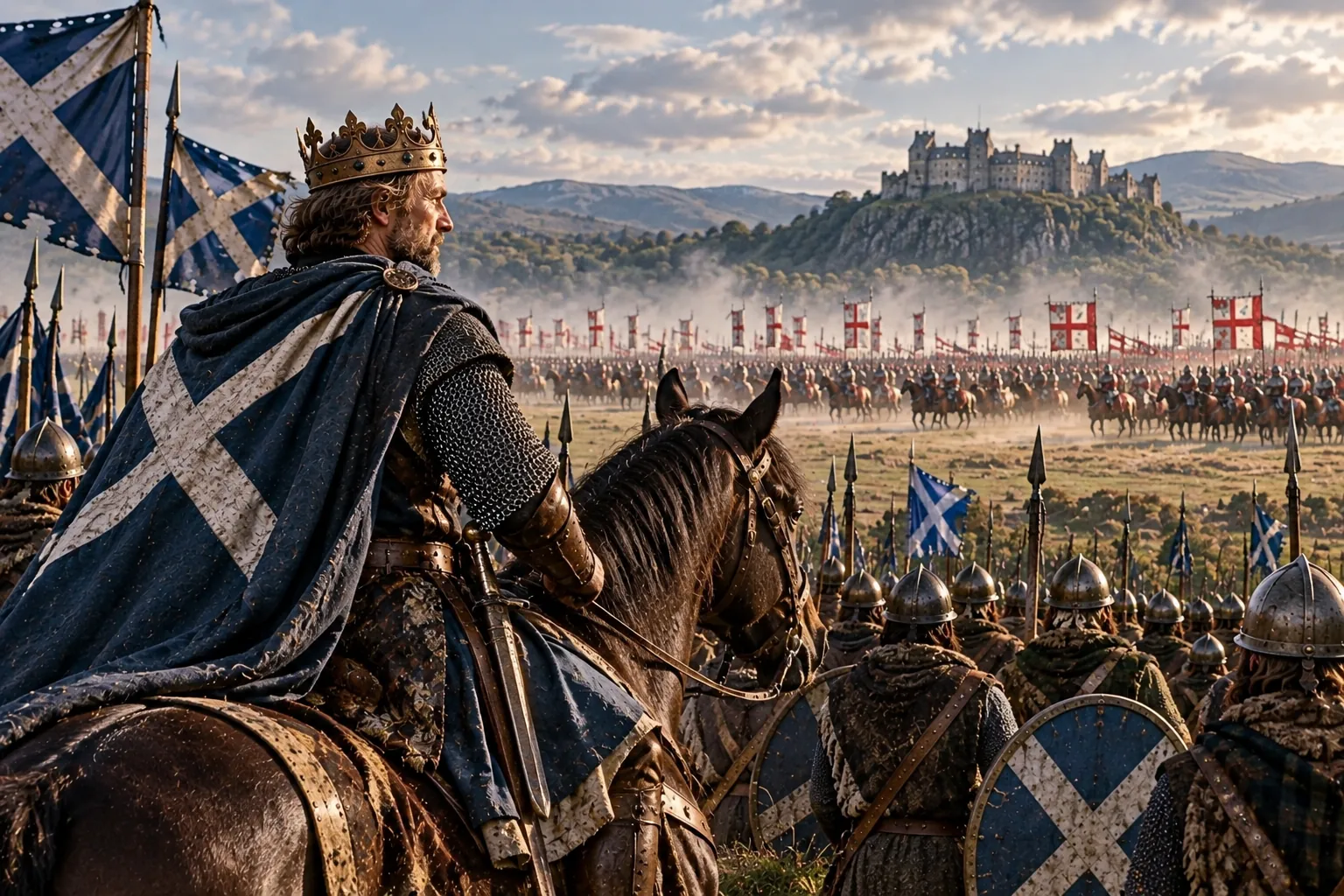
An English king marched north with a mighty army. Waiting for him was Robert the Bruce, a Scottish king who had spent eight years fighting for his crown. What happened over two days in June 1314 would change Scotland’s history forever.
The English were coming.
Somewhere beyond the woodland south of Stirling Castle, thousands of soldiers were marching north. Their banners moved above the advancing columns, while heavily armoured knights rode alongside men carrying spears, bows and shields.
At the head of this great army was King Edward II of England.
He had come to crush the Scottish resistance and rescue Stirling Castle.
Waiting for him was Robert the Bruce.
Eight years earlier, Bruce had been crowned King of Scots. Since then, he had known defeat, betrayal and the desperate experience of being hunted through his own kingdom.
There had been times when his cause seemed almost hopeless.
But those days were behind him.
Now, in June 1314, Bruce stood with an army of experienced soldiers, determined to defend the kingdom they had fought so hard to reclaim.
The English outnumbered them.
Their mounted knights had helped defeat Scottish armies before, and Edward II expected his superior forces to carry the day.
But Bruce had chosen where he would fight.
And this time, the Scots would not be easily driven from the field.
The Road to Stirling
The trouble had begun months earlier.
Bruce’s younger brother, Edward Bruce, had been besieging Stirling Castle, one of the most important English-held strongholds remaining in Scotland.
The castle’s commander, Sir Philip Mowbray, had agreed to surrender unless an English army arrived to relieve him by midsummer.
It was an agreement that left Edward II under enormous pressure.
Losing Stirling would be another humiliating blow to English authority in Scotland.
So he gathered a powerful army and marched north.
News of its approach reached Robert the Bruce, who began preparing his men.
He knew what had happened at Falkirk in 1298, when William Wallace’s Scottish army had suffered a devastating defeat.
There, English archers and cavalry had helped break the Scottish resistance.
Bruce had no intention of repeating that disaster.
He chose ground near the New Park, south of Stirling, where woodland and uneven terrain could make it difficult for English knights to use their horses effectively.
His soldiers carried long spears and fought in tightly packed formations known as schiltrons.
But Bruce had learned an important lesson.
His men would not simply stand still and wait for the English to attack.
When the moment came, they would advance together.
A King and a Broken Axe
On 23 June 1314, the English army approached the Scottish positions.
The first encounters began near the New Park.
Bruce was riding ahead of his soldiers when an English knight named Sir Henry de Bohun reportedly spotted him.
It was an extraordinary opportunity.
If de Bohun could kill the Scottish king, the battle might be over before it had properly begun.
The English knight lowered his lance and charged.
Bruce was mounted on a smaller horse and carried a battle-axe.
Imagine the scene.
A heavily armoured knight thundering towards the Scottish king, his lance pointed directly at him.
The men watching must have feared the worst.
But Bruce waited until the last moment.
Then he turned his horse aside.
As de Bohun passed, Bruce rose in his stirrups and brought his axe crashing down upon the knight.
De Bohun fell dead.
The force of the blow reportedly shattered the shaft of Bruce’s axe.
When the Scottish king returned to his soldiers, his commanders were furious.
He had risked his life unnecessarily, and the entire Scottish cause might have been lost.
Yet according to the traditional account, Bruce seemed more concerned about his broken axe.
The story comes from medieval chronicles, and we cannot know every detail with certainty.
Nevertheless, it became one of the most famous moments in Scottish history.
For the soldiers who saw their king survive the encounter, it must have been an extraordinary sight.
And the fighting was only beginning.
The First Day Belongs to Scotland
The English cavalry continued their attempts to break through the Scottish positions.
But Bruce’s men stood firm.
Their long spears presented a dangerous barrier to the charging horses, while the surrounding terrain restricted the English movements.
Elsewhere, another English mounted force attempted to reach Stirling Castle.
Standing in its way was Thomas Randolph, Earl of Moray.
Randolph’s soldiers formed a schiltron and prepared to meet the attack.
The English knights charged, but the Scottish formation held together.
Again and again, the horsemen failed to break through.
Eventually, the English withdrew.
By the end of the first day, the Scots had successfully resisted the English advance.
Bruce had good reason to be encouraged.
But he knew the main English army remained intact.
The following morning would bring a much greater test.
The Night Before Everything Changed
As darkness settled over the countryside, the fighting stopped.
Imagine standing among the Scottish soldiers that evening.
Beyond the trees lay the English army, still vastly larger than their own.
Men would have checked their weapons, tended to their horses and prepared for whatever the morning might bring.
Some had followed Bruce through years of hardship.
Others may have remembered the stories of Wallace and the terrible defeat at Falkirk.
They knew what English cavalry could do to men caught in the open.
Yet something had changed.
That afternoon, they had watched English knights charge and fail.
They had seen their king ride back alive after a deadly encounter.
Perhaps victory no longer seemed impossible.
Across the battlefield, Edward II and his commanders faced their own problems.
Their army had failed to force a passage through the Scottish positions.
The ground was difficult, and the Scots had shown unexpected determination.
Still, the English possessed the larger army.
Surely, they believed, another day’s fighting would settle the matter.
Neither side could know how dramatically the next few hours would unfold.
The Morning Scotland Fought Back
On 24 June 1314, Robert the Bruce made his decision.
The Scots would advance.
It was a bold choice.
For years, Scottish armies had struggled against English cavalry in open battle. Now Bruce intended to move directly towards a larger English force.
The Scottish soldiers formed their schiltrons.
Long spears projected from the ranks as the men closed together.
Then they began moving forward.
Across the battlefield, English soldiers watched the Scottish formations approaching.
This was not the scattered resistance they might have expected.
The Scots were advancing as a disciplined army.
English cavalry attempted to meet them.
But the Scottish spears made a direct charge extremely dangerous.
Horses could not easily force their way through the tightly packed formations.
Behind the English front ranks, more soldiers pressed forward, struggling to find enough room to fight.
The battlefield was becoming crowded.
Bruce had chosen his ground well.
The English army possessed superior numbers, but it could not bring all its strength against the Scots at once.
And still the Scottish spears moved forward.
The Battle Turns
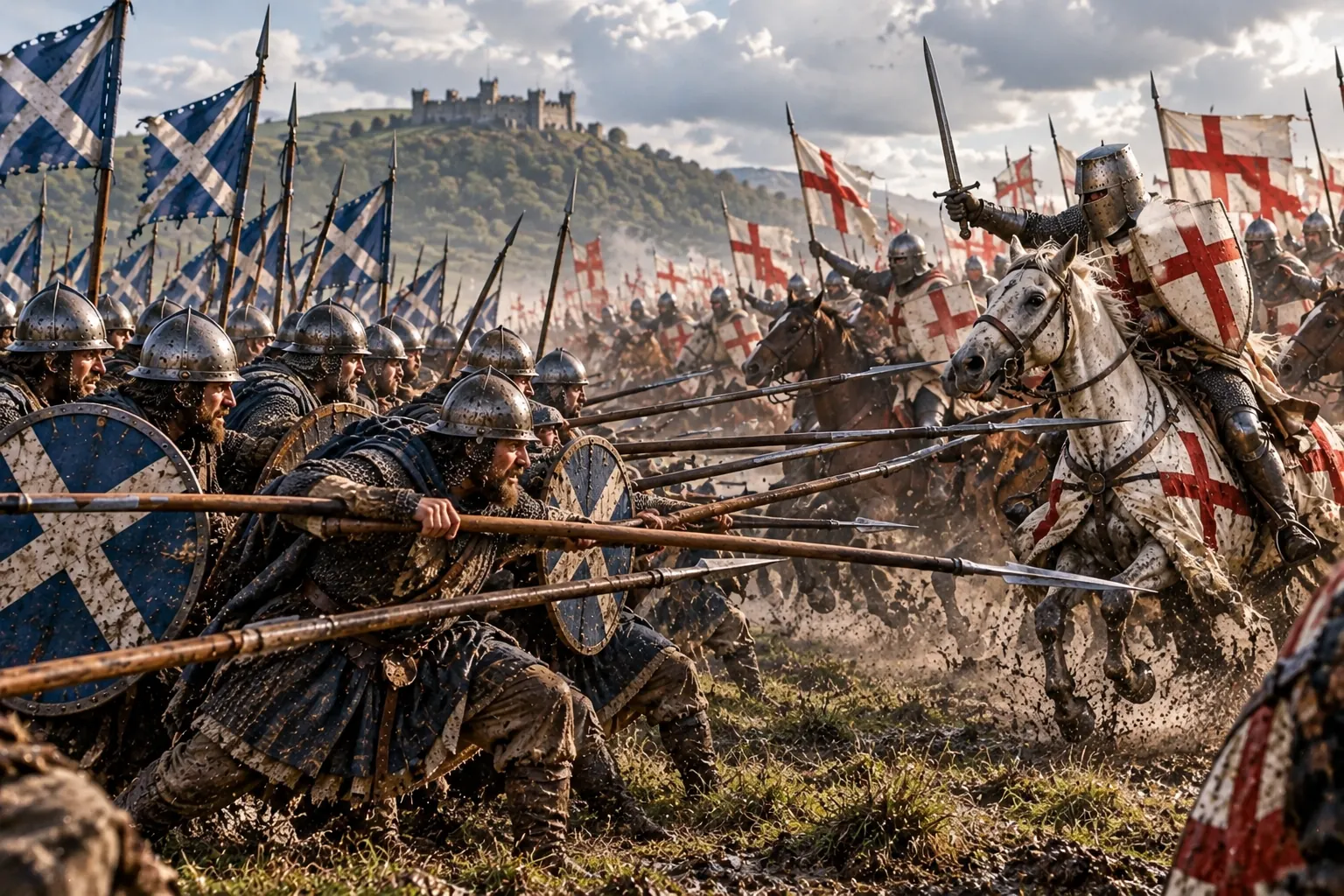
The English knights came forward.
Across the crowded battlefield, armoured horsemen urged their mounts towards the advancing Scottish lines.
Ahead of them stood a forest of spears.
The Scots closed ranks.
There was nowhere to hide now.
The first English horsemen approached, but the Scottish spearpoints made it almost impossible to charge straight through. Horses recoiled, riders struggled to find an opening, and the men behind pressed forward.
The Scottish line held.
Then it moved.
One step.
Another.
The long spears pushed forward as the Scots advanced together, forcing the English to give ground.
The battlefield was becoming a nightmare for Edward II’s army.
Thousands of soldiers crowded onto ground that offered little room to manoeuvre. Knights struggled to turn their horses, while infantry found themselves trapped behind the fighting.
Orders were shouted, but in the confusion of battle, who could hear them?
And still the Scots came forward.
For the English soldiers at the front, the danger was immediate. They faced an advancing wall of spearpoints, with their own army pressing behind them.
Then English archers began trying to bring their bows into action.
Bruce knew what that could mean.
Sixteen years earlier, English archery had helped destroy William Wallace’s army at Falkirk.
But Bannockburn would not follow the same course.
Scottish mounted troops, traditionally associated with Sir Robert Keith, attacked an English archery force, disrupting its efforts to halt the advance.
The English archers were dangerous, but they could not deliver the decisive blow that Edward’s army needed.
The pressure on the English lines grew.
Men stumbled. Horses struggled. Soldiers tried desperately to find space to fight.
Then something began to change.
The English were no longer advancing.
They were falling back.
At first, the retreat was uneven. Some knights continued fighting while others tried to withdraw.
But the Scots gave them little time to recover.
The schiltrons pressed onwards.
The English army, which had marched north so confidently, was beginning to break apart.
And somewhere behind those struggling ranks, King Edward II was about to witness the collapse of his campaign.
When the English Army Broke
As the Scottish advance continued, the English army lost its ability to fight as a united force.
Some soldiers attempted to retreat.
Others were trapped in the confusion.
The Earl of Gloucester, one of England’s most important nobles, was killed during the fighting.
Then came the moment that confirmed the disaster.
King Edward II was escorted away from the battlefield.
The English king had come north to defeat Robert the Bruce.
Now he was fleeing from the army he had expected to destroy.
As the English lines collapsed, men scattered across the surrounding countryside.
Some tried to escape across streams and difficult ground. Others were killed or captured during the retreat.
The Scots pursued them.
The English army had suffered a crushing defeat.
And when the fighting finally ended, Robert the Bruce stood victorious.
After eight years of hardship, uncertainty and war, he had defeated the army of the English king.
The man who had once struggled simply to survive had achieved the greatest military victory of his reign.
The Castle That Started It All
Above the surrounding countryside stood Stirling Castle.
It was the fortress Edward II had marched north to save.
Now there would be no rescue.
With the English army defeated, the castle’s commander honoured the earlier agreement and surrendered to Bruce.
The Scottish king then ordered its defences dismantled, preventing the English from easily using the fortress again.
It was a remarkable reversal of fortune.
Only a few years earlier, Bruce had been a fugitive king with enemies across Scotland.
Now he controlled much of the kingdom and had defeated one of the largest English armies sent against him.
But Bannockburn did not bring an immediate end to the war.
England still refused to recognise Scotland’s independence.
There would be more fighting, more negotiations and more difficult years ahead.
Yet something fundamental had changed.
Robert the Bruce had proved that his kingdom could resist an English royal army and win.
Standing at Bannockburn Today
More than seven hundred years have passed since those two remarkable days.
The soldiers are gone, the battlefield has changed, and the exact location of the second day’s fighting remains debated.
But the story has never disappeared.
Today, visitors to Bannockburn can stand near the famous equestrian statue of Robert the Bruce, looking across the countryside towards Stirling.
Nearby, the Battle of Bannockburn Visitor Centre tells the story of the armies and the events that unfolded in June 1314.
It is a peaceful place now.
Yet as you look across the landscape, it is not difficult to imagine the English banners approaching through the distance.
Or the Scottish soldiers gathering beneath their king.
Or the moment when the schiltrons began their advance.
Perhaps the most remarkable part of Bannockburn is not simply that a smaller Scottish army defeated a larger English force.
It is the journey that brought Robert the Bruce there.
He had lost battles.
He was driven from his kingdom.
He had watched friends and supporters die.
And there must have been moments when even he wondered whether his struggle could succeed.
But on 24 June 1314, everything he had fought for came together.
Bannockburn did not end Scotland’s struggle for independence.
Formal recognition would come fourteen years later, through the Treaty of Edinburgh–Northampton in 1328.
But Bannockburn gave the Scottish kingdom a victory that generations would remember.
And it secured Robert the Bruce’s place among the most celebrated figures in Scottish history.
Where to Next?
The story does not end at Bannockburn.
Six years later, Scotland’s nobles would make another stand for their kingdom.
This time, they would not carry spears or swords.
They would put their determination into words.
In 1320, a remarkable letter was sent to Pope John XXII, defending Scotland’s right to remain an independent kingdom.
It became known as the Declaration of Arbroath.
And that is where our journey through Scottish history takes us next.
If you enjoyed this story, explore our other articles about William Wallace, the Battle of Stirling Bridge, the Battle of Falkirk (1298), Robert the Bruce and Stirling Castle.
Share this article with anyone who enjoys Scottish castles, medieval battles and the stories of the people who shaped history.
Discover more at brianwelsh500.com.
Pingback: Robert the Bruce: The King Who Fought for Scotland